Fishin' Frenzy: What Happens When You Actually Play
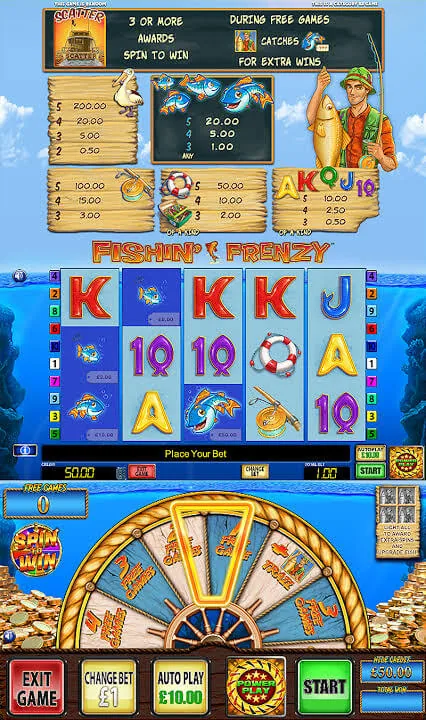
Most players chase the free-spins fisherman on their first session, land the feature twice in twenty minutes, then wonder why the next hour delivers nothing but dead spins. That's medium volatility working exactly as designed: Fishin' Frenzy doesn't drip-feed small wins the way a fruit machine does, and it doesn't vanish your balance in three spins like a high-variance slot. It sits in the middle, which means the distance between bonus rounds can feel longer than you expect—even when the maths says you're on track.
Blueprint Gaming released Fishin' Frenzy in 2014, and it became one of the most recognised slots on UKGC-licensed sites. The cartoon aesthetic, the simple mechanic, and the fisherman wild that collects prizes during free spins made it a fixture in UK online casinos. By November 2026 it's still widely available, joined by a sprawling series of sequels and spin-offs that share the same core idea but vary the features and volatility. This page covers the original five-reel, ten-line version—the one that started it all.
The First Ten Minutes: What You'll See Before the Feature Lands
You pick a stake between £0.10 and £5.00 per spin—or £2.00 if you're 18 to 24, because of the UK age-based stake cap introduced in 2025. The game runs on five reels and ten fixed paylines; you can't adjust the number of lines. Press spin, and the reels stop to show a mix of low-value card ranks (ten through ace) and higher-value symbols: a lifebelt, a fishing rod, a tackle box, and a pelican. The fisherman in the yellow mac is the wild; he substitutes for everything except the scatter.
In the base game the fisherman doesn't collect prizes—he just completes lines like any other wild. The scatter is a «Free Spins» buoy; land three or more anywhere on the reels and you trigger ten free spins. That's the only feature. No pick-me bonus, no wheel, no cascading reels. Most of your first ten minutes will be base-game spins that pay between nothing and two or three times your stake when a mid-value symbol lines up with a wild. The £250 maximum win ceiling means a five-of-a-kind pelican at £5.00 stake pays £50.00, not the full paytable value, but that cap rarely matters at lower stakes.
The RTP of 96.12 per cent sits just above the UK market average. Over a long sample, the game returns £96.12 for every £100 wagered, but short sessions swing wide: you might burn through £20.00 without seeing the feature, or land it twice in fifty spins and finish ahead. Medium volatility means the swings are neither gentle nor extreme; expect five- to ten-minute gaps between features during a typical hour, with clusters of dead spins in between.
The Free-Spins Feature: How the Fisherman Collects Prizes
Three or more scatter buoys trigger ten free spins. During the feature, every fish symbol that lands on the reels shows a cash value: between 2× and 50× your total stake per fish. The fisherman wild now collects every visible fish value when he appears on the same spin. If you see four fish worth 5×, 10×, 15×, and 20× and a fisherman lands on reel three, he gathers all four—50× total—in one go. Multiple fishermen on the same spin collect independently, so two wilds mean two separate hauls of every fish on screen.
You can't retrigger free spins; once the ten spins finish, you're back to the base game. The feature accounts for most of the slot's RTP: land a spin with a dozen high-value fish and a couple of fishermen and you'll see 200× or 300× your stake in a single free spin. The maximum win during the feature is capped at 5,000× total stake, which arrives at £250.00 on a £0.50 spin or hits the £250 session ceiling at higher stakes.
A typical feature pays between 10× and 80× your stake. Occasionally you'll trigger the round, see no fishermen across all ten spins, and collect only the fish values that line up on paylines—those spins feel flat because the mechanic didn't activate. Other times you'll land fishermen on six or seven spins and walk away with 150× or more. The variance inside the feature is wide, which is why two consecutive triggers can feel utterly different.
The First Week: Patterns, Dry Spells, and What Actually Repeats
Play Fishin' Frenzy for a few sessions and you'll notice the base game can stretch. Eighty or a hundred spins without a feature isn't unusual; the scatter frequency is low enough that hour-long droughts happen. When the feature does land, you'll find that one in every three or four triggers pays less than 20× your stake, because the fishermen either don't show up or arrive on spins with only a couple of low-value fish. The big wins—100× and above—come from stacked combinations: six or more fish on screen, two fishermen, and a decent spread of 20× to 50× fish values.
- The base game rarely pays more than 10× your stake on a single spin; most line wins sit between 0.5× and 3×.
- Feature frequency averages around one trigger per 120–150 spins, but clumps and gaps are normal.
- Inside the feature, fishermen appear on roughly half of the ten free spins in a typical round; sometimes you'll see one on every spin, sometimes none at all.
- The highest single-spin result during free spins usually comes from a screen crowded with high-value fish and multiple wilds collecting them all.
Because the game has no progressive multiplier, no sticky wilds, and no retrigger, the free spins play out the same mechanical loop ten times. You either get collecting spins or you don't. That simplicity is part of the appeal: there's no need to track meters or gamble features, but it also means variance is all you have. A hundred-quid session might yield three features that pay a combined 60× your stake, or one feature that returns 200× and covers the entire session. The RTP is constant; the path to it is anything but.
Over a week of casual play—thirty or forty quid across a dozen sessions—you'll probably see the feature eight to twelve times. Most will pay modestly; one or two might deliver triple-digit multiples. The slot doesn't build toward a climax; every spin is independent. That's the trade-off: no complexity, no learning curve, but also no sense that persistence improves your odds. The maths is the same on your first spin and your thousandth.
How to Play: Stake, Spin, Collect—and When to Walk
- Set your stake using the coin-value controls. Remember the £5.00 cap applies to every spin, and if you're 18 to 24 the ceiling is £2.00. The game will enforce the limit automatically on a UKGC-licensed site.
- Press spin or activate autoplay. Autoplay runs between ten and a hundred spins at your chosen stake; you can set a single-win limit or a loss limit to stop the sequence early. The game has no turbo mode, but spins resolve quickly enough that manual play feels brisk.
- Wait for three scatter buoys to trigger the feature. When free spins start, the fisherman collects every fish prize visible on spins where he lands. You don't choose anything; the feature plays out automatically.
- After ten free spins the round ends and any collected prizes are added to your balance. You're returned to the base game, and the cycle repeats.
There's no skill element, no decision tree, no optimal moment to stop the reels. The RNG determines every outcome before the animation plays. When you win, the amount is credited instantly; when you lose, the stake is deducted and the next spin is independent of the last. The only control you have is stake size and whether to continue playing.
Walking away after a big feature win is a sensible discipline, not because the game is «due» a cold streak—probability doesn't work that way—but because a 200× windfall gives you a natural exit point while you're ahead. Chasing losses by raising your stake only burns your balance faster; the RTP doesn't improve, and volatility doesn't care how much you've already spent.
Where to Play, What to Expect on Mobile, and How Demo Mode Works
Fishin' Frenzy runs on desktop and mobile browsers; Blueprint Gaming built it in HTML5, so it adapts to phone and tablet screens without an app download. The interface scales down cleanly: stake controls sit along the bottom edge, the reels fill the centre, and the paytable opens as an overlay. On a small screen the fish prizes during free spins can be hard to read at a glance, but the collecting mechanic works identically. Touch controls respond quickly; there's no lag between taps and spins, even on mid-range Android devices.
Demo mode is available on most UKGC-licensed sites, but you'll need to register and verify your age before the site shows you the free-play version. The demo uses the same RNG, RTP, and paytable as the real-money game; the only difference is that wins are credited in play-money units. Demo mode is useful for learning the feature mechanic and getting a feel for how often the fisherman actually collects, but it won't give you a reliable preview of what fifty quid of real spins will look like—variance is too wide for that.
| Demo mode | Real money | |
|---|---|---|
| RTP | 96.12% | 96.12% |
| Feature frequency | Same | Same |
| Volatility | Medium | Medium |
| Wins paid | Play money | GBP to your balance |
| KYC required | Age check only | Full identity & document check |
When you switch to real money, you'll deposit using a UK debit card, PayPal, Apple Pay, or Open Banking. The site will ask for proof of identity and address before your first withdrawal; that verification takes twenty-four to forty-eight hours. Withdrawals to e-wallets clear within a few hours; Faster Payments to your bank take the same day to two working days, and debit-card withdrawals can take one to three working days. Every site serving UK players needs a UKGC remote licence; the licence number sits in the footer, and you can check it against the Commission's public register.
Blueprint's original Fishin' Frenzy is still the most common version, but the developer has released more than a dozen variants: Fishin' Frenzy Megaways, Fishin' Frenzy Power 4 Slots, Fishin' Frenzy Even Bigger Catch, and others. Each changes the reel layout, volatility, or feature mechanics. The original ten-line version remains the simplest and the most recognisable; if you're new to the series, start here before trying the higher-variance sequels.
FAQ
Does the fisherman always collect fish during free spins?
No. Fish symbols appear randomly on every free spin, and the fisherman wild also appears randomly. If a spin shows six fish but no fisherman, nothing is collected—those fish values only pay if they line up on a payline. On average the fisherman lands on about half the free spins in a ten-spin round, but it's common to trigger the feature and see him once or not at all.
Can you retrigger the free spins or extend the round?
No. The original Fishin' Frenzy gives you ten free spins when you land three or more scatter buoys, and that's the entire feature. Once the ten spins finish, you return to the base game. Some of the later sequels introduced retrigger mechanics, but the 2014 version you'll find on most UK sites does not have that option.
Why do two feature rounds feel so different even at the same stake?
Because of variance inside the feature. One round might deliver fishermen on eight spins with high-value fish on screen, paying 250× your stake. The next round might show fishermen twice, with only a handful of low-value fish, paying 15×. Both outcomes sit within the game's medium-volatility range; the RNG doesn't smooth results across consecutive features. Over hundreds of triggers the average payout converges on the expected value, but in any short sample the swings are wide.